
Tunisian vs Spanish vs Italian Olive Oil: Buyer's Comparison
Published on July 8, 2026 · Updated on July 12, 2026 · 8 min
By the Virginia trading team · reviewed by Tarek Neffati, president
Origin is the first line of any olive oil contract: it drives the sensory profile, the price, the supply risk and what your label is legally allowed to say. Spain, Italy, Greece and Tunisia account for the bulk of world supply, and they run four very different industrial models. For a professional buyer, the useful question is not "which origin is best" but "what does each origin bring to my specification — and when is Tunisian origin the right call".
Four origins, four industrial models
Spain sets the pace of the world market. With 1,419,000 t produced in the 2024/25 crop year and roughly 1.4 million tonnes expected for 2025/26 according to the International Olive Council (IOC), Spain accounts for 40% or more of world output in a normal year. Its model: intensive and super-intensive irrigated groves concentrated in Andalusia, very large cooperatives and massive storage capacity. The practical consequence for buyers: Spanish prices (the Jaén basin) are the global benchmark, and every other origin trades at a spread to them.
Italy plays a double role: premium producer and the world's blending hub. Its production — 248,000 t in 2024/25, around 300,000 t estimated for 2025/26 — covers neither domestic consumption nor the needs of its export-oriented bottling industry. So Italy imports heavily, in the region of 450,000 to 500,000 t per year, to blend, bottle and re-export under its brands. That is not a weakness; it is the core skill of Italian bottlers, the world's largest buyers of bulk olive oil — Tunisian included.
Greece is the extra virgin specialist. Output runs between 200,000 and 250,000 t depending on the campaign, dominated by the Koroneiki variety, with one of the highest extra virgin shares in the Mediterranean. A significant part of the volume has historically moved in bulk to Italian packers.
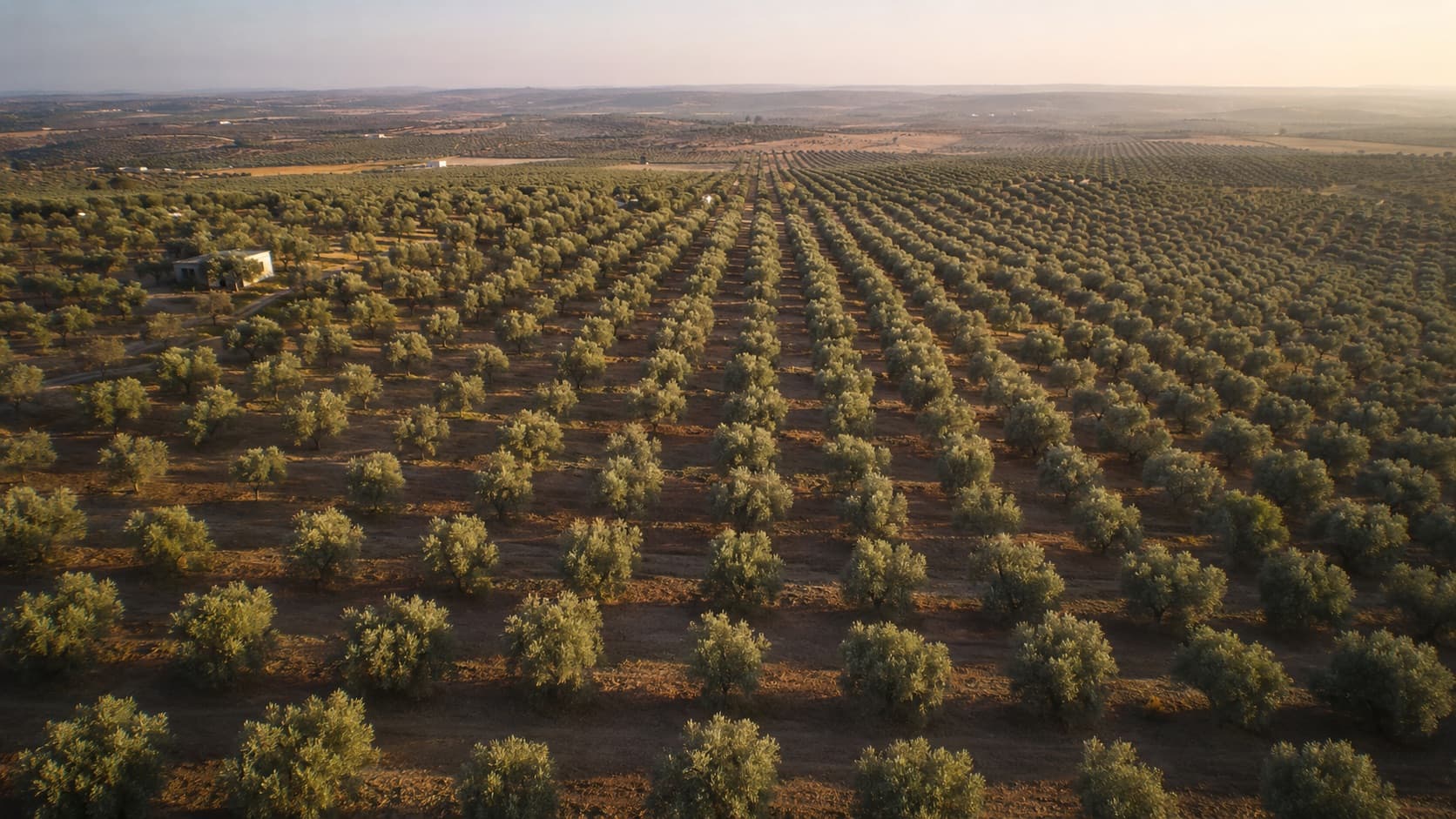
Tunisia is the non-EU heavyweight, built for export. 340,000 t in 2024/25 and an estimated 450,000 t for 2025/26 — a record level. Regularly the world's second to fourth largest exporter depending on the campaign, it ships close to 85% of its volumes in bulk: the domestic market is small and the orchard works for export. Its agronomic model is the mirror image of Spain's: a mostly rain-fed, dry-farmed orchard, low inputs, and one of the largest organic olive areas in the world. For a full picture of this origin, see our guide to Tunisian olive oil.
| Origin | Production (IOC, recent campaigns) | Dominant model | Flagship varieties | Typical profile | Relative price position | Organic |
|---|---|---|---|---|---|---|
| Spain | 1,419,000 t (2024/25); ~40-45% of world | Intensive/super-intensive irrigated, large co-ops | Picual, Hojiblanca, Arbequina | From structured (Picual) to mild (Arbequina) | Market benchmark | Developed, minor share of volume |
| Italy | 248,000 t (2024/25); world's top importer | Fragmented groves, powerful blending industry | Coratina, Ogliarola, Frantoio | Intense Coratina; varied regional profiles | Image premium on Italian origin | Present, limited volumes |
| Greece | 200,000-250,000 t by campaign | Traditional groves, high extra virgin share | Koroneiki | Grassy green fruit, clear pungency | Usually between Spain and Italy | Present |
| Tunisia | 340,000 t (2024/25), ~450,000 t est. 2025/26 | Rain-fed dry farming, low inputs, bulk export | Chemlali, Chetoui, Oueslati, Zarrazi | Mild, ripe Chemlali; green, polyphenol-rich Chetoui | Usually below Spain at equal grade | Among the world's leading organic orchards |
Varieties and profiles: what each origin contributes to a blend
A bottler does not think in flags. It thinks in a target profile — bitterness, pungency, fruitiness, stability — and sources each component wherever it offers the best value.
- Picual, Hojiblanca, Arbequina (Spain): Picual brings structure, frank bitterness and some of the best oxidative stability available; Hojiblanca bridges the middle; Arbequina delivers mild, round, crowd-pleasing oils that are more fragile against oxidation.
- Coratina, Ogliarola (Italy): Coratina from Puglia, very rich in polyphenols, works as a character corrector — a few percentage points are enough to straighten out a flat blend. The softer Ogliarola balances southern Italian blends.
- Koroneiki (Greece): clean grassy fruit and good shelf stability, the backbone of Greek extra virgin.
- Chetoui and Chemlali (Tunisia): northern Chetoui delivers intense green fruit and high polyphenol levels — functionally comparable to a Coratina inside a blend. Chemlali from the centre and south gives a mild oil with ripe, almondy fruit, playing the role an Arbequina usually plays. The full breakdown is in our article on Chetoui and Chemlali, the two defining Tunisian varieties.
The takeaway: Tunisia alone covers both poles of a blend — the mild volume component and the polyphenol corrector — at a price position generally more favourable than its European equivalents.
Relative pricing: why Tunisia trades below Spain
At equal grade — same free acidity, same K232/K270, same zero-defect panel median — bulk Tunisian extra virgin generally trades below its Spanish equivalent, which itself trades below Italian. Four mechanisms explain this, and none of them is about quality:
- The label drives demand. Brands and private labels declaring "EU origin" or "origin Spain" cannot incorporate Tunisian oil without changing their origin statement. The broadest demand therefore concentrates mechanically on EU origins, and non-EU oil trades at a structural discount.
- The image premium. Italy monetises decades of shelf recognition; Tunisia, long sold anonymously inside other people's blends, is only beginning to build its own origin premium.
- EU market access has a cost. Outside the annual duty-free quota of 56,700 t — opened on 1 January and usually exhausted quickly — Tunisian oil pays duties or moves under inward processing for re-export. Buyers price in that cost and paperwork.
- A bulk-oriented selling structure. A harvest concentrated between October and January/February, mills with cash-flow needs and limited storage: Tunisian supply arrives early and sells fast, which weighs on early-season prices.
The operational conclusion: the Spain-Tunisia spread at equivalent COA is a documentable buying opportunity, not a signal of lower quality. The certificate of analysis and the tasting decide — not the flag.
Supply security: two kinds of variability
- Spain: a concentrated water risk. Two consecutive drought campaigns pushed production below 700,000 t in 2022/23 — half a normal year — and stretched the world market like rarely before. When Andalusia runs dry, every origin gets more expensive.
- Tunisia: rain-fed groves absorb shocks differently. Without irrigation, output swings widely from one campaign to the next, roughly by a factor of two. But North African rainfall does not follow the Iberian pattern: the troughs do not always land in the same years. In the recent period, Tunisia rebounded to 340,000 t and then towards 450,000 t while other basins contracted.
- The answer: diversify origins. Two or three qualified origins, campaign contracts rather than systematic spot buying, and a smart reading of the calendar: the Tunisian harvest runs from October to January/February, with new-crop oil exportable before year-end.
Labelling: what each sourcing option lets you print
For virgin and extra virgin olive oils sold in the EU, the origin statement is mandatory (Delegated Regulation (EU) 2022/2104 and CMO Regulation 1308/2013). A bottler faces three cases:
- Single origin — "origin Spain", "origin Tunisia" — only allowed if 100% of the oil comes from the country stated.
- EU blend — "blend of olive oils of European Union origin".
- Blend including non-EU oil — "blend of olive oils of European Union and non-European Union origin", or "not of European Union origin" alone.
In other words, putting Tunisian oil into a blend is entirely legal but visible on the label; and an assumed "origin Tunisia" label is a differentiating position, not a fallback. The detailed rules — sales denominations, print size, harvest year — are covered in our article on EU olive oil labelling rules.
When Tunisian origin is the right call — and when to blend
- Competitive private label extra virgin: at a comparable COA profile, Tunisian origin supports a cost price EU origins cannot always match, with a clean origin statement. See our availability of bulk Tunisian olive oil.
- Organic at volume: the rain-fed, low-input orchard supplies certifiable organic oil in quantities few origins can match.
- Polyphenols and early harvest: early-picked Chetoui reaches the levels sought for the health claim under Regulation (EU) 432/2012.
- A mild, consensual profile: Chemlali offers the round, ripe fruit that food service and much of retail ask for.
- Multi-origin blending: to hold a constant profile year after year despite each basin's swings, Tunisia is a reliable, well-priced blend component — exactly how Italian and Spanish bottlers use it.
Compare on evidence with Virginia
The only origin comparison that matters is run sample against sample, COA against COA. That is exactly the exercise we offer: put a Tunisian extra virgin — early harvest, organic, virgin or lampante, drawn from the more than 30,000 t per campaign of our partner mills — up against your Spanish or Italian references, full certificate attached (free acidity, peroxide value, K232/K270/ΔK, polyphenols on request) and independent SGS-type counter-analysis available at loading. Request samples and decide on evidence, not on the flag.
Read next
Market
Olive Oil 2026/27 Season: Early Signals on Price and Supply
Tunisia's 2025/26 export campaign closes at record volumes while Spain and Italy send mixed early signals for 2026/27 — what bulk buyers should do before autumn.
August 26, 2026 · 7 min read
Market
PDO and PGI for Tunisian olive oil: what it changes
Téboursouk, the first Tunisian olive oil PDO, has been protected across the EU since 2024. Here is what geographical indications change for B2B sourcing.
August 24, 2026 · 7 min read
Tell us what you need.
Volume, grade, packaging, destination: describe your project and we'll get back to you within one business day with an offer at the best price — or the right questions.