
Tunisian Olive Oil: The Complete Guide for Professional Buyers
Published on July 6, 2026 · Updated on July 12, 2026 · 7 min
By the Virginia trading team · reviewed by Tarek Neffati, president
Tunisia is one of the world's leading olive oil exporters and a major player in organics, with a distinction few origins can claim: an orchard grown overwhelmingly dry-farmed, without irrigation, on local varieties with a marked profile. For a European bottler, blender or importer, it is an origin that is both competitive and differentiating. This guide covers the essentials: history, varieties, regions, sensory profiles and how to buy.
Three millennia of olive growing
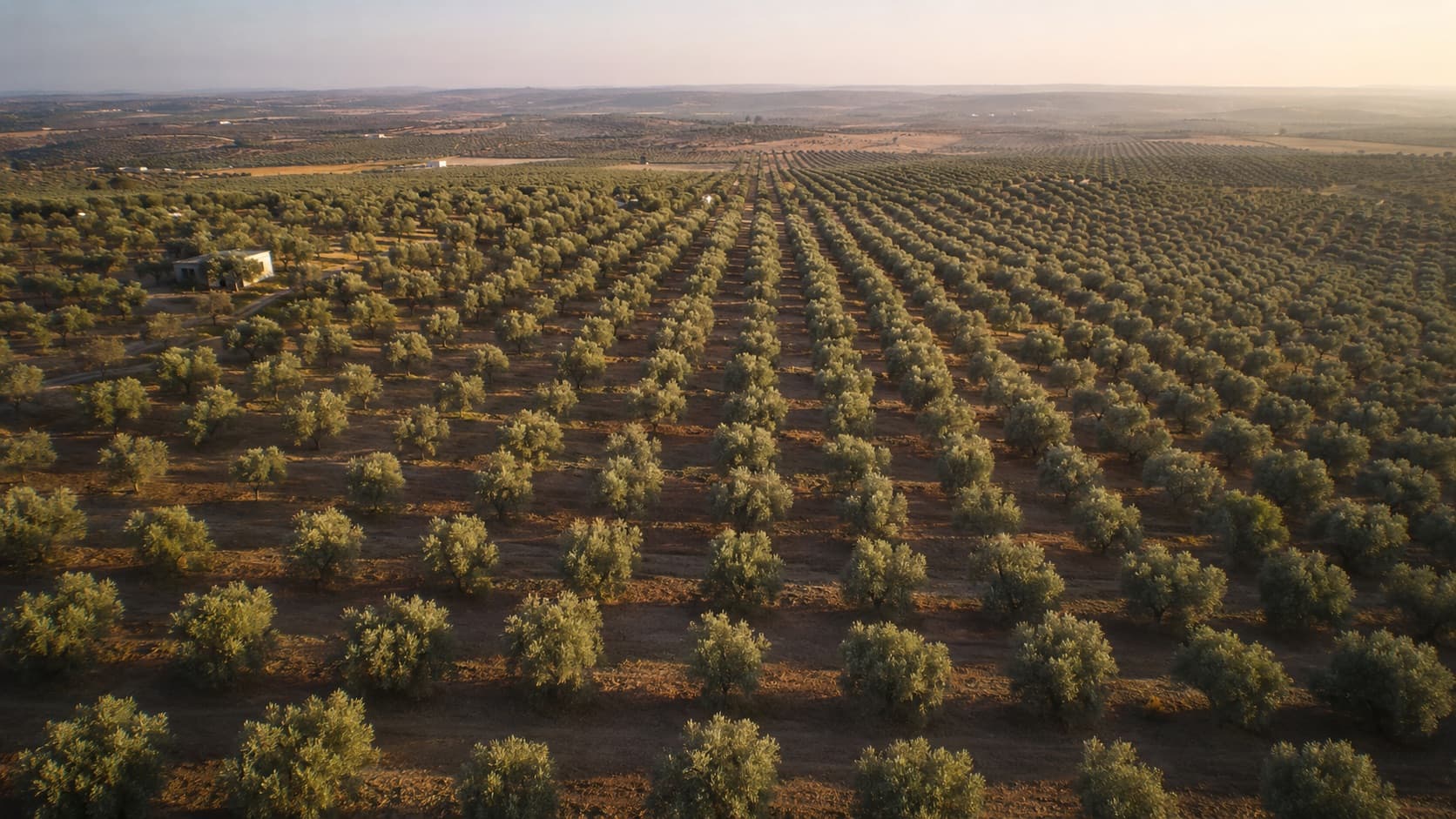
The olive tree is not an opportunistic crop in Tunisia: it is a historical bedrock. The Phoenician trading posts and then Carthage structured oil production and trade on this coastline very early. Under Roman rule, the province of Africa — with present-day Tunisia at its heart — ranked among Rome's major olive oil suppliers: ancient presses, amphorae and mills unearthed at archaeological sites across the country still bear witness to it. That historical depth has a very concrete effect today: milling and trading know-how passed down without interruption, and a dense network of mills across the entire territory.
A dry-farmed orchard
Most of the Tunisian orchard is rain-fed: the trees receive only what falls from the sky, at low planting densities that give each olive tree a large volume of soil to explore. This growing model has three consequences for the buyer:
- More variable yields from one season to the next, at the mercy of rainfall — the flip side of the coin, to be factored into your sourcing strategy.
- Concentrated oils, from fruit less swollen with water, with forthright aromatic profiles.
- Naturally favorable ground for organics: low input pressure, extensive plots, easier conversion. This is what has made Tunisia one of the world's foremost producers of organic olive oil.
Chetoui and Chemlali: two varieties, two profiles
The Tunisian orchard rests on two dominant varieties, complementary right down to their geography.
Chetoui: intense green fruitiness
Planted in the north of the country, Chetoui yields oils with character: intense green fruitiness, herbaceous and artichoke notes, present bitterness and pungency, and natural richness in polyphenols. That antioxidant structure gives it excellent keeping ability and makes it a sought-after oil for lifting flat blends or for premium and health-focused positioning.
Picking date shapes this profile further: harvested early, in October-November, Chetoui yields oils with exuberant green fruitiness and peak polyphenol levels, hotly contested at the start of the campaign; picked later, it softens and loses part of that intensity. The same logic applies to every variety in the country: the earlier the harvest, the greener, more bitter and more age-worthy the oil — at the cost of a lower oil yield, which the lot's price reflects.
Chemlali: round smoothness
Dominant in the center and south, around Sfax and the Sahel, Chemlali produces smooth oils with ripe fruitiness, almond notes and discreet pungency. It is a consensus profile, appreciated by markets that shy away from bitterness, and a widely used blending base for rounding out more aggressive oils.
The other varieties
Oueslati (Kairouan region) and Zarrazi (south) complete the picture, with intermediate profiles that appeal to buyers looking for something distinctive. They remain a minority of exported volumes.
| Variety | Dominant region | Sensory profile | Typical use |
|---|---|---|---|
| Chetoui | North | Intense green fruitiness, bitter, pungent, polyphenol-rich | Premium, health positioning, structuring blends |
| Chemlali | Sfax, Sahel, center | Smooth, ripe fruitiness, almond notes | Large volumes, round blends |
| Oueslati | Kairouan | Balanced, medium fruitiness | Differentiation, single-variety oils |
| Zarrazi | South | Ripe fruitiness, arid-zone typicity | Specialty lots |
The main production regions
- The North (from Bizerte to Béja): wetter lands, Chetoui's stronghold, green and structured oils.
- The Sahel (east coast, around Sousse and Monastir): historic coastal olive growing, predominantly Chemlali.
- The Sfax region: the economic capital of the olive tree, immense rain-fed orchards, and the country's highest density of mills and export infrastructure.
- The South (Médenine, Zarzis): arid-land olive growing, more modest volumes but genuine typicity.
Tunisia's place in the world market
Outside the European Union, Tunisia is, depending on the season, the world's largest olive oil exporter or among the very largest. Most volumes leave in bulk for the major bottling and blending countries — Spain and Italy first — where Tunisian origin goes into blends or is bottled under brand. A growing share is also exported packaged, driven by the upmarket move of Tunisian brands and by demand for organics, a segment where the country holds a front-rank position. Flows to the European Union partly fall under the annual duty-free quota opened by Regulation (EC) No 1918/2006, a calendar parameter every importer needs to know.
The 2025-2026 campaign shows the scale of that potential: the International Olive Council (IOC) and the Tunisian industry put production between 450,000 and 500,000 tonnes — a record that would make the country the world's second-largest producer behind Spain — and the agricultural observatory ONAGRI counted 327,400 tonnes exported over the first seven months, up 57.9% year on year. For a buyer, volumes on that scale mean rare depth of supply and negotiating windows that stay open late into the campaign.
Why European blenders turn to it
Three reasons come up again and again with our customers:
- The quality-price profile: low-acidity extra virgins, available in volume, at competitive terms versus European origins, especially in years of a small Spanish crop.
- Aromatic complementarity: Chemlali softens, Chetoui structures. Tunisian origin gives the blender both tools.
- Documentary security: serious exporters provide full analyses and lot-level traceability — the certificate of analysis reads as we explain in our COA guide.
How to buy Tunisian olive oil
- Choose the grade: extra virgin (acidity ≤ 0.8%, zero sensory defects), virgin, or grades destined for refining. The lot's COA is the reference, never the commercial label alone.
- Time the calendar: harvest runs from October to January; the best buying windows fall in the early and middle parts of the season, as detailed in our article on the season and pricing.
- Choose the format: bulk in flexitank or isotank for industrial volumes, drums and IBCs for fractional needs, private-label bottles for resale — see our bulk offer.
- Validate on samples: no decision on a spec sheet alone; tasting and counter-analysis on a sealed sample of the actual lot.
Buying the Tunisian origin: where to start
For a buyer who has never worked the origin, the safest path takes three steps, spread over one campaign.
Step one: a qualified trial volume. Start from your end use — blending, bottling as-is, private label — and have two or three matching lots quoted, analysis certificates attached. A first container in drums or IBCs, or a full flexitank if your volumes allow it, is enough to validate how the oil behaves in your process without committing the cash of an annual programme.
Step two: qualify the documentation and the supplier. Demand, for every lot, the full COA, the certificate of origin and traceability back to the crushing mill; taste the sealed sample against the certificate. An exporter who provides all of this without friction, and accepts an independent counter-analysis at loading, has passed the best filter there is.
Step three: move to a season contract. Once the profile is validated and the logistics chain runs smoothly, contracting over several staggered shipments stabilises your average price and guarantees availability, while keeping a spot share for opportunities. At that point you are buying the origin the way Spanish and Italian bottlers have for decades.
Working the Tunisian origin with Virginia
From Chetoui country in the north to the vast groves of Sfax, Virginia's partner mills cover every profile described in this guide — over 30,000 tons per season, each lot backed by its analysis certificate and quoted at direct-from-source prices. To form your own view of the origin, nothing replaces tasting it: request samples of Chetoui and Chemlali side by side from the current season and put them up against your current references.
Read next
Market
Olive Oil 2026/27 Season: Early Signals on Price and Supply
Tunisia's 2025/26 export campaign closes at record volumes while Spain and Italy send mixed early signals for 2026/27 — what bulk buyers should do before autumn.
August 26, 2026 · 7 min read
Market
PDO and PGI for Tunisian olive oil: what it changes
Téboursouk, the first Tunisian olive oil PDO, has been protected across the EU since 2024. Here is what geographical indications change for B2B sourcing.
August 24, 2026 · 7 min read
Tell us what you need.
Volume, grade, packaging, destination: describe your project and we'll get back to you within one business day with an offer at the best price — or the right questions.