
Tunisia Olive Oil Production: Key Figures and Export Data
Published on July 11, 2026 · Updated on July 12, 2026 · 7 min
By the Virginia trading team · reviewed by Tarek Neffati, president
Tunisia devotes roughly 1.8 million hectares to olive trees, produces anywhere from 100,000 to 500,000 tonnes of olive oil depending on the crop year, and consistently ranks among the world's top two exporters. This page gathers the reference numbers on the origin — groves, production, exports, organic area, milling capacity — each with its source: the International Olive Council (IOC), Tunisia's national agriculture observatory ONAGRI and the National Oil Office ONH. A factual baseline for any buyer sizing up Tunisian supply.
The groves: a third of the country's farmland
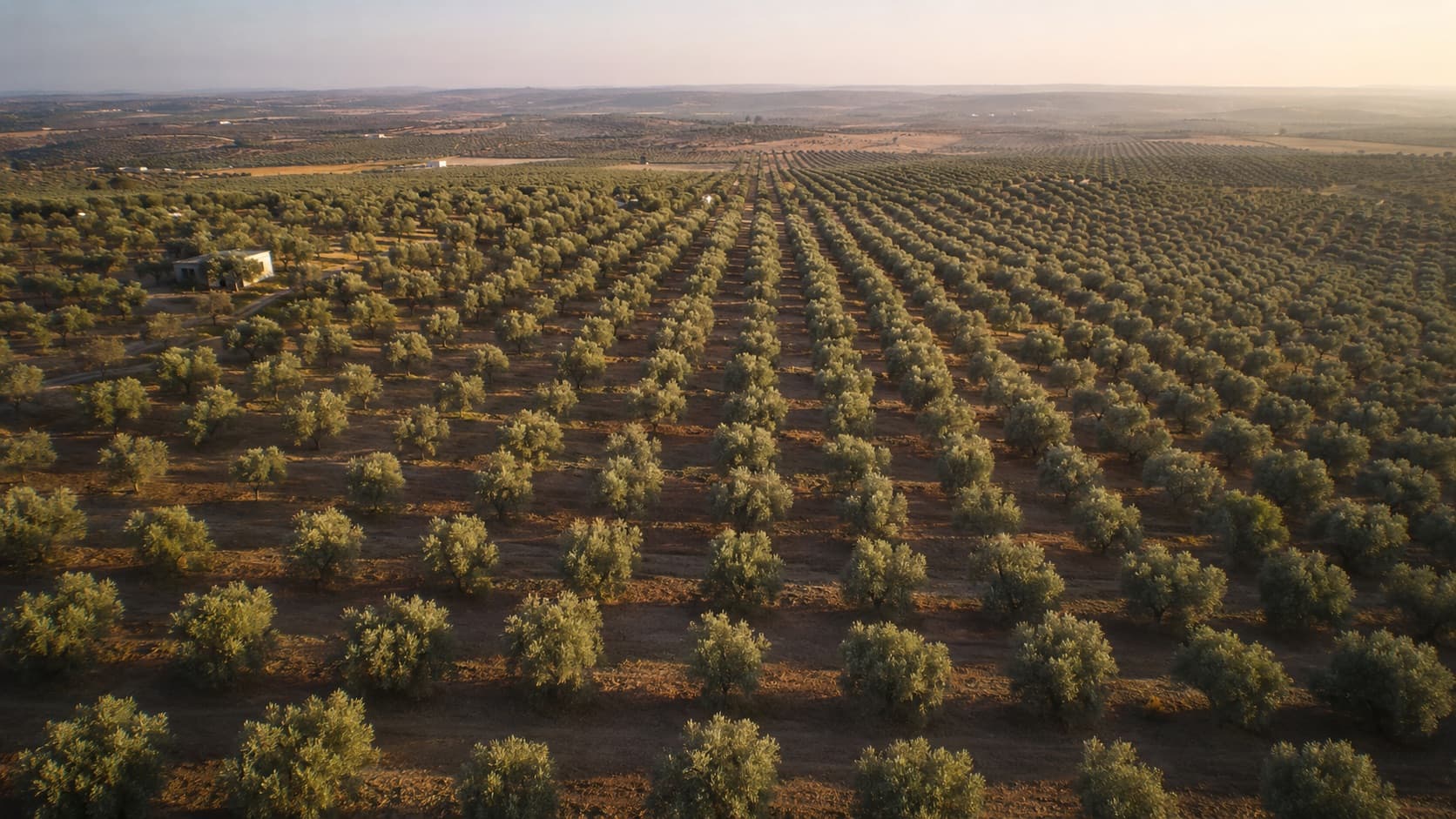
Olives are not one crop among many in Tunisia — they are the backbone of its agriculture. Sector studies (ONAGRI, regional development offices) converge on the following orders of magnitude:
- Around 1.8 million hectares planted with olive trees, close to one third of all agricultural land and roughly 79 percent of the country's tree-crop area.
- 80 to 100 million trees depending on the estimate and the pace of new plantings, spread across some 310,000 farms — Tunisian olive growing is above all a smallholder economy.
- About 95 percent of the groves are rain-fed, with no irrigation. That explains the character and aromatic concentration of the oils, and the sensitivity of output to rainfall.
Planting density tracks the rainfall map: around 100 trees/ha in the north (400-600 mm of annual precipitation), 50-60 trees/ha in the centre, and as few as 17-20 trees/ha in the arid south. The centre — Sfax, the Sahel, Sidi Bouzid, Kairouan — holds the largest share of trees and volume, with Sfax the historic capital of the trade, while the north (dominated by the Chetoui variety) supplies the intense green-fruity profiles sought for premium programmes. For the map of profiles by region and variety, see our guide to Tunisian olive oil.
| Zone | Typical density | Rainfall | Dominant profile |
|---|---|---|---|
| North (Beja, Bizerte, Zaghouan…) | ~100 trees/ha | 400-600 mm | Chetoui, green fruitiness, high polyphenols |
| Centre (Sfax, Sahel, Kairouan) | 50-60 trees/ha | 300-350 mm | Chemlali, ripe fruitiness, mild |
| South (Medenine, Zarzis…) | 17-20 trees/ha | 200-250 mm | Zarrazi and local varieties |
Production: a one-to-four swing between crop years
Tunisian output is structurally alternating: a 95 percent rain-fed orchard produces to the rhythm of rainfall and the tree's biological cycle. Over the past decade, production has swung from under 100,000 tonnes in drought years to more than 400,000 tonnes in bumper years, with the historic record around 440,000 tonnes in 2019/20.
Recent crop years, per IOC and ONAGRI data:
| Crop year | Production | Reading |
|---|---|---|
| 2022/23 | ~180,000 t | Drought trough |
| 2023/24 | ~220,000 t | Moderate recovery |
| 2024/25 | ~340,000 t (IOC provisional) | Up 55 percent year on year |
| 2025/26 | 450,000-500,000 t (IOC and Tunisian Ministry of Agriculture forecasts) | Potentially a record, pending final data |
That output makes Tunisia the largest producer and exporter outside the European Union, and the second to fourth producer worldwide depending on the year — behind Spain, competing head-to-head with Italy, Greece and Turkey. Worth noting: unlike European producing countries, Tunisia consumes little of its own production, so nearly all of it is available for export. And even in lean years the origin does not vanish: after two drought campaigns, 2023/24 still shipped over 180,000 tonnes abroad per ONAGRI. Buyers who work the origin steadily track the IOC's twice-yearly balances and ONAGRI's monthly bulletins — both public, and both ahead of supplier price lists in signalling where the market is going.
Exports: the hard-currency engine of Tunisian agriculture
Tunisia exports most of what it produces, which makes it a pivotal player in world trade. ONAGRI data from recent campaigns tells the story:
- 2024/25 campaign: about 250,000 tonnes shipped over the first ten months (up 39 percent year on year), yet revenue fell roughly 30 percent as world prices deflated from the 2023-2024 peaks.
- 2025/26 campaign: 327,400 tonnes exported over the first seven months (November-May), up 57.9 percent, for more than 4 billion dinars in receipts (up 44.9 percent) per ONAGRI — an exceptional export run on the back of the record harvest.
- Quality mix: extra virgin accounts for 78 to 83 percent of exported volume depending on the campaign.
- Bulk versus packaged: bulk still represents 85 to 87 percent of volume; packaged oil is inching up (13-15 percent), pushed by a national move upmarket.
On destinations, three markets absorb over 70 percent of volume: Italy (~27 percent), Spain (~25 percent) and the United States (~20 percent), with the EU taking about 57 percent of the total and North America 27 percent (ONAGRI, 2024/25). Spain and Italy buy mostly in bulk for their blends; the US drives demand for packaged and organic oil. The EU also grants an annual duty-free quota of 56,700 tonnes (Regulation (EC) No 1918/2006), the linchpin of the European flow.
The economic weight goes beyond trade: according to IOC and CIHEAM studies, the sector supports more than one million people directly or indirectly, generates around 34 million workdays per year (over 20 percent of agricultural employment) and accounts for 40 to 50 percent of the value of Tunisia's agri-food exports in strong years.
Organic: the largest certified olive area in the world
Tunisia is officially recognised as number one worldwide for certified organic olive area, with close to 144,000 hectares of certified groves according to the Tunisian Ministry of Agriculture — ahead of Italy and Spain. Rain-fed groves that receive few inputs by nature convert at low cost: that is the origin's structural advantage. Available volumes, EU equivalence and price premiums are covered in detail in our article on organic Tunisian olive oil in bulk.
The industry: 1,700 mills and a deliberate move upmarket
Tunisia's processing base is dense and decentralised: around 1,700 working mills (ONH counts and sector fact sheets), with national crushing capacity estimated between 34,000 and 45,000 tonnes of olives per day. Modern two-phase continuous lines operate alongside traditional presses; serious exporters work with the former, on stainless-steel tanks under nitrogen.
The National Oil Office (ONH), founded in 1962, long held the export monopoly, liberalised in the mid-1990s. Today it plays a regulating role — buying and stockpiling to steady the market — alongside quality control and promotion of the Tunisia origin brand.
National strategy is pushing packaged oil and brands: Tunisian oils now collect dozens of awards every year in international competitions — around ten at the 2025 NYIOOC in New York, plus strings of gold medals at regional contests. The signal for buyers is unambiguous: top-end Tunisian oil competes with the best European origins, on more competitive buying terms.
What these numbers mean for a buyer
- Genuine depth of supply. With 250,000 to 500,000 exportable tonnes in good years, Tunisia can feed large industrial programmes — extra virgin through lampante — without draining the market.
- Alternation belongs in your contracts. An origin that swings one-to-four between years argues for locking certain requirements into campaign contracts while keeping a spot allocation — the mechanics are laid out in our review of the 2025-2026 harvest and pricing.
- Buying windows follow the harvest. December-January for peak availability, autumn to reserve early-harvest green fruities; late in the campaign the offer narrows and quality premiums firm up — see our breakdown of bulk Tunisian olive oil prices.
- The bulk/packaged gap is an opportunity. An origin that ships 85 percent in bulk leaves value on the table for downstream players: blending, contract bottling, private label.
Secure Tunisian supply with Virginia
These statistics translate into something very concrete: across the more than 30,000 tonnes our network of partner mills represents each campaign, every lot stays tied to its mill of origin and documented by its COA — the country's scale, with traceability on top. To move from orders of magnitude to an actual supply programme, request a quote — qualified within 24 business hours — or explore our bulk offer.
Read next
Market
Olive Oil 2026/27 Season: Early Signals on Price and Supply
Tunisia's 2025/26 export campaign closes at record volumes while Spain and Italy send mixed early signals for 2026/27 — what bulk buyers should do before autumn.
August 26, 2026 · 7 min read
Market
PDO and PGI for Tunisian olive oil: what it changes
Téboursouk, the first Tunisian olive oil PDO, has been protected across the EU since 2024. Here is what geographical indications change for B2B sourcing.
August 24, 2026 · 7 min read
Tell us what you need.
Volume, grade, packaging, destination: describe your project and we'll get back to you within one business day with an offer at the best price — or the right questions.