
Organic Tunisian Olive Oil in Bulk: The Buyer's Guide
Published on July 8, 2026 · Updated on July 12, 2026 · 7 min
By the Virginia trading team · reviewed by Tarek Neffati, president
Sooner or later, every buyer sourcing organic olive oil in bulk ends up looking at Tunisia. The country holds one of the largest organic olive orchards on the planet and ships tens of thousands of tonnes of certified extra virgin every season to Italy, Spain, the United States and France. That dominance is not a marketing accident — it follows from how the orchard itself is farmed. Here is why, and more importantly how to buy Tunisian organic in bulk on solid ground: certification, paperwork, premium and end markets.
An orchard that was organic-compatible before organic existed
Converting a farm to organic normally comes down to one trade-off: giving up synthetic inputs without wrecking yields or costs. The Tunisian orchard starts ahead, because it was never built on those inputs in the first place.
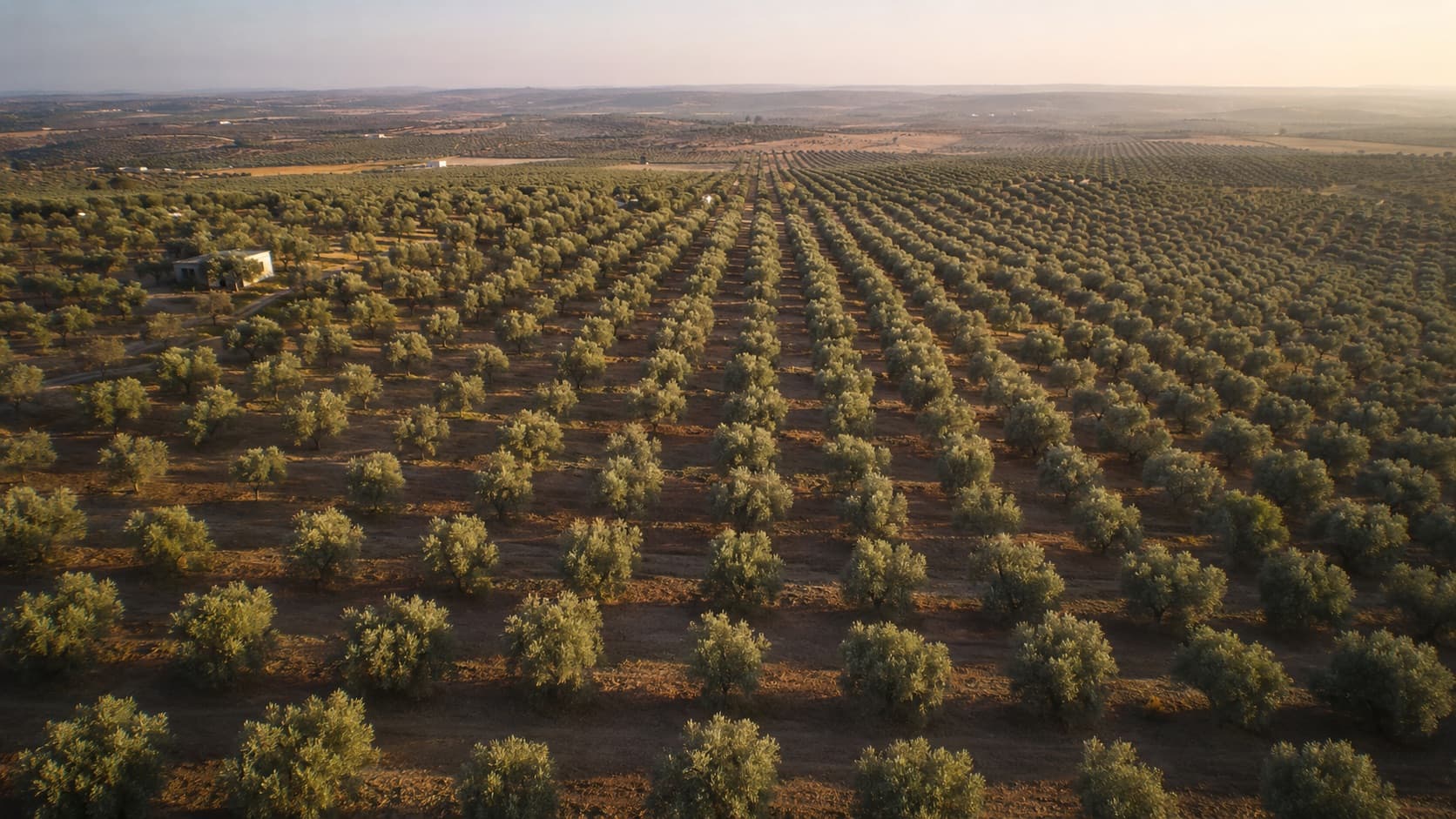
- Dry farming: the vast majority of Tunisian olive groves are rain-fed, with no irrigation. Less water means less vegetative vigour and less fungal pressure — so there are very few treatments to remove when converting.
- Low densities, extensive plots: in the centre and south, traditional plantings drop below 20 trees per hectare. That natural spacing limits pest spread and makes much of the spray programme used in intensive groves simply unnecessary.
- Historically low input pressure: across a large share of the orchard, synthetic fertiliser and plant-protection treatments have always been marginal — as much an economic choice as a technical one.
- Easier conversion: the conversion period for perennial crops (three years before the harvest can be sold as organic) can be shortened where the absence of prohibited products on a plot is documented — a common situation in Tunisia.
This agronomic base, covered in more depth in our complete guide to Tunisian olive oil, explains an apparent paradox: organic production, expensive to run elsewhere, is here a natural extension of how the orchard was already farmed.
Tunisian organic in numbers
Tunisia is regularly ranked first worldwide for organic olive production — a ranking drawn from the global organic statistics compiled by FiBL — and its authorities present the country as the world's leading exporter of organic olive oil. A few orders of magnitude to frame the picture:
- Over 140,000 hectares of certified organic olive groves according to official Tunisian data — one of the largest organic olive orchards in the world, within a national organic farming area exceeding 230,000 hectares.
- Olive oil accounts for roughly 80% of the country's organic exports: it is the engine of the entire Tunisian organic sector.
- In the 2025-2026 season, organic olive oil exports passed 44,000 tonnes in the first seven months alone, according to official figures.
- Italy and Spain together take more than 60% of the volumes; the United States absorbs about a quarter, France most of the rest.
One detail says everything about the link between this origin and organic: Sfax-based CHO Group markets its Bulk by CHO offer as the "world's largest producer of organic extra virgin olive oil". That claim says less about one company than about one origin — this leadership was built in Tunisia, and it rests on a network of certified mills far broader than any single integrated player.
Certification: how Tunisian organic reaches your market
European Union: a recognised equivalent system
Tunisia is on the EU's list of third countries whose organic production and control system is recognised as equivalent. In practice: oil certified in Tunisia by an approved control body can be marketed as organic in the EU without re-certification. Two points deserve attention:
- The regime is evolving: Regulation (EU) 2018/848 provides for these equivalence arrangements to be gradually replaced by bilateral trade agreements. Check the framework in force when you sign — your control body or forwarder will know the current status.
- Every consignment needs an electronic certificate of inspection, endorsed in TRACES before release for free circulation, and the importer must itself be registered as an organic operator. This import certificate should not be confused with the IOC, the International Olive Council.
United States: NOP, with no equivalence deal
There is no organic equivalence arrangement between the United States and Tunisia. To sell as "organic" on the US market, both mill and exporter must be NOP-certified by a USDA-accredited certifier — the major control bodies operating in Tunisia offer this as a dual certification alongside EU organic. Since the Strengthening Organic Enforcement rule, every import must additionally be covered by an electronic NOP Import Certificate.
Who audits on the ground
Control is carried out by international certification bodies established in Tunisia — Ecocert and CCPB among them — within a national framework that predates most origins: Tunisia passed its organic farming law back in 1999, with oversight from the Ministry of Agriculture and technical support from the CTAB institute. Annual audits, unannounced inspections and residue testing are the normal regime for a certified operator.
The organic premium: how the price gap forms
Organic oil trades above the equivalent conventional grade for three mechanical reasons:
- Certification costs: annual control-body fees, audits and record-keeping — borne by every link in the chain (grove, mill, exporter).
- Segregation logistics: dedicated tanks, validated cleaning, smaller lots, identity preserved from mill to flexitank. Every handling step costs more in organic.
- Supply and demand: certified volumes are finite, and demand from organic bottlers is structural.
The premium is not a fixed number. It is negotiated season by season, widens when demand outruns available certified supply, and narrows in heavy-crop years. It also varies by grade — a premium early-harvest organic extra virgin is not priced like a standard organic destined for blending. Spread across a bottled litre of organic private label, the bulk premium generally remains absorbable within organic shelf pricing.
What to demand on an organic lot
- Operator organic certificates: mill and exporter, valid, verifiable online on the control body's portal.
- Lot-to-certificate linkage: the certificate covers the company; require proof that the specific lot falls under it (volume, season, product).
- A full COA for the lot: free acidity, peroxide value, K232/K270/ΔK — the thresholds to check are detailed on our quality and certifications page.
- A multi-residue pesticide analysis: a screening covering several hundred molecules. This is the strong suit of rain-fed Tunisian organic: with so little input pressure upstream, results typically come back below limits of quantification.
- Mill traceability: identification of the mill of origin, dedicated tanks, lot history through to sealed loading.
- The import certificate: TRACES for the EU, NOP Import Certificate for the US — to be arranged with the forwarder before departure.
Conventional vs organic: what changes for the buyer
| Item | Conventional extra virgin | Organic extra virgin |
|---|---|---|
| Documents | Lot COA, standard export paperwork | COA + operator and lot organic certificates + import certificate (TRACES EU / NOP US) |
| Controls | Physico-chemical and sensory analysis | Same + annual certifier audit + multi-residue analysis |
| Price | Seasonal market reference | Variable premium driven by certified supply and demand |
| Logistics | Standard | Dedicated tanks and containers, identity preserved to the client |
| Typical outlets | Blending, private label, food service, industry | Organic private label, certified cosmetics, US NOP market, premium retail |
The end markets pulling demand
- Organic private label: extra virgin olive oil is a traffic driver of organic retail ranges, and the Tunisian origin makes a competitive shelf price achievable without giving up on quality.
- Certified cosmetics: organic olive oil is a sought-after raw material for formulators, with its own documentary requirements — we cover them in our article on olive oil for the cosmetics industry.
- The US market: the United States ranks among the top buyers of Tunisian organic. Dual EU + NOP certification opens both markets from the same orchard and the same mill — shipped in flexitank or ISO tank from Tunisia, as described on our bulk Tunisian olive oil page.
Secure your organic supply with Virginia
On an organic lot, Virginia's offer arrives with the paperwork attached: the partner mill's organic certificates and the lot's linkage to them, a full COA, a multi-residue analysis — plus NOP where the US market is the target. Segregation is held through to loading, with SGS counter-analysis available. Tell us your volumes and your certifier: a qualified answer within 24 business hours, samples and analysis reports included.
Read next
Market
Olive Oil 2026/27 Season: Early Signals on Price and Supply
Tunisia's 2025/26 export campaign closes at record volumes while Spain and Italy send mixed early signals for 2026/27 — what bulk buyers should do before autumn.
August 26, 2026 · 7 min read
Market
PDO and PGI for Tunisian olive oil: what it changes
Téboursouk, the first Tunisian olive oil PDO, has been protected across the EU since 2024. Here is what geographical indications change for B2B sourcing.
August 24, 2026 · 7 min read
Tell us what you need.
Volume, grade, packaging, destination: describe your project and we'll get back to you within one business day with an offer at the best price — or the right questions.