
Halal Certification for Bulk Olive Oil: A Buyer's Guide
Published on August 12, 2026 · 7 min
By the Virginia trading team · reviewed by Tarek Neffati, president
An extra virgin olive oil — a pure plant product with no alcohol and no animal-derived processing aid — raises no theoretical question of halal permissibility. But for a buyer targeting Saudi Arabia, the UAE, or Malaysia, "halal by nature" and "halal certified" are two different things: import authorities across the Gulf and Southeast Asia require a certificate from a body they recognize, issued against a specific standard. Between GSO 2055-1, OIC/SMIIC 1, and Tunisia's own INNORPI label, the halal supply chain has its own checkpoints, from the grove to the container. Here is how it works and what to verify before signing.
Halal by nature: a starting point, not a certificate
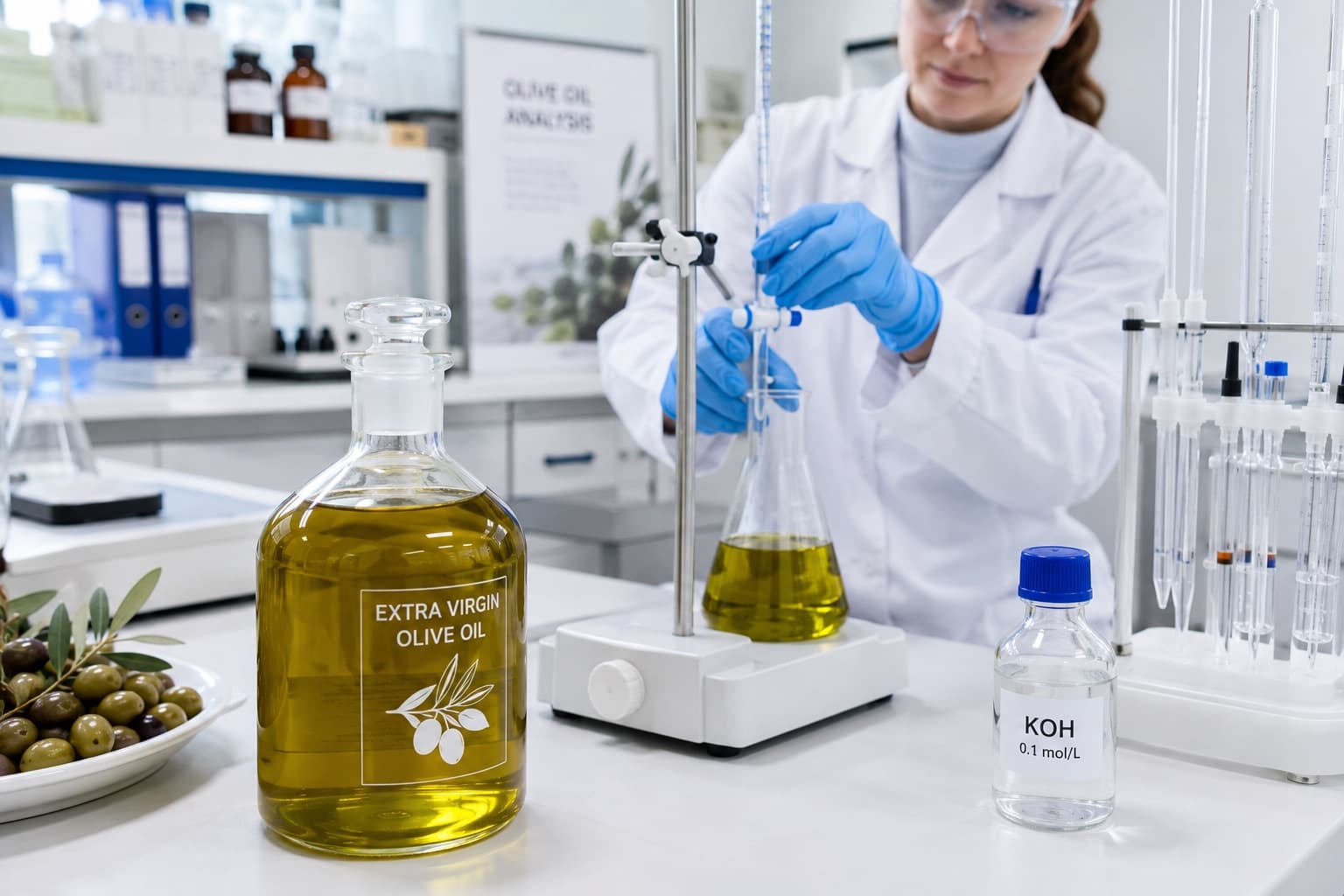
An olive oil extracted by simple mechanical pressing or centrifugation, with no additive and no animal-derived processing aid, already meets the core of what permissibility requires: it is a fruit juice, free of alcohol and of any doubtful (mashbouh) ingredient. That intrinsic fact is not, on its own, enough for a Saudi buying group, an Emirati distributor, or a Malaysian marketer, none of whom will accept a lot without the seal of a body they recognize. Halal certification works as a documented trust system: it confirms that every stage — receiving the olives, storage, transport, packaging — has been audited, not simply that the source fruit is permissible.
The risk certification exists to cover is not the fruit itself but the chain around it: a storage tank shared with an alcohol-containing product, an ethanol-based cleaning agent, or a container that carried a non-halal cargo without documented treatment is enough to strip an otherwise analytically flawless lot of its status.
GSO 2055-1, OIC/SMIIC 1: the standards that matter
There is no single global halal standard, but a small set of frameworks covers most of Tunisia's export markets:
| Standard | Body | Scope | Markets covered |
|---|---|---|---|
| GSO 2055-1:2015 | Gulf Standardization Organization (GSO) | General requirements for halal food, from receiving through distribution | Saudi Arabia, UAE, Qatar, Kuwait, Bahrain, Oman |
| GSO 2055-2:2021 | GSO | Requirements for halal certification bodies themselves | Accreditation of certifiers active in the Gulf |
| UAE.S 2055-1 | ESMA (United Arab Emirates) | Emirati national transposition of the GSO framework | United Arab Emirates |
| OIC/SMIIC 1:2019 | SMIIC, a body linked to the OIC | Stricter general requirements, including on converting lines that previously handled non-halal product | Turkey and member states of the Organisation of Islamic Cooperation |
| INNORPI halal label | INNORPI (Tunisia) | Tunisian national certification, created in 2013 with the Diwan Al-Iftaa | Tunisian exports, recognized by JAKIM (Malaysia) since 2019 |
The point a buyer needs to remember: the applicable standard depends on the destination market, not the country where the oil originates. An oil compliant with the INNORPI label does not automatically clear Saudi customs unless the certifying body is itself accredited under GSO 2055-2.
The audit protocol, from mill to container
Certification is never issued against a single lot; it covers a site and a full process, audited before the first liter ever sells under the seal. The auditor checks the origin of the olives and the absence of animal-derived processing aids, confirms storage tanks are not shared with non-halal product without a documented conversion treatment — something OIC/SMIIC 1:2019 specifically governs for lines that have been in contact with non-halal goods — and reviews the cleaning agents used on the line, which must be alcohol-free.
The exact scope of the certificate needs a line-by-line read: some bodies cover the full chain, from receiving the olives through final packaging, others only the bottling stage. That distinction matters a great deal if your oil moves in bulk between the mill and the bottling site, with a hand-off to document. Renewal generally runs on an annual cycle, with follow-up audits set by the risk classification the certifying body applies — a point worth getting in writing before committing volume.
INNORPI, Tunisia's certifying body, and its international reach
In Tunisia, the INNORPI (National Institute for Standardization and Industrial Property) issues the national halal label, created in 2013 in partnership with the Diwan Al-Iftaa, the office of Tunisia's Grand Mufti. In December 2019, following an audit mission by its own experts on the Tunisian system, Malaysia's JAKIM recognized the INNORPI label — an agreement that opens the Asian market to certified Tunisian products, olive oil and dates chief among them. That cooperation deepened further in 2026, with new bilateral exchanges between Tunisia and Malaysia on halal trade.
According to African Manager, around forty Tunisian companies held halal certification in 2026, with more than 30% of them concentrated in dates and olive oil alone — two of the country's flagship export products. That is still a small pool relative to market potential, and a genuine differentiator for a buyer who structures sourcing upstream rather than at order time. A caution for buyers targeting the Gulf rather than Asia: JAKIM recognition does not equal GSO accreditation — a lot destined for Saudi Arabia or the UAE needs a certifying body accredited under GSO 2055-2, checked independently of the INNORPI label carried by the originating mill.
Bulk and transport: the segregation question
Bulk shipping introduces a constraint the mill audit alone does not cover: supervision continuity all the way to the container. A flexitank is single-use by design, which sidesteps most cross-contamination questions compared with a reusable isotank, whose cleaning history then needs documentation the certifying body deems sufficient — particularly if the same container previously carried an alcohol-containing product or animal fat. Either way, the paper trail needs to establish an unbroken chain: mill attestation, numbered seals, loading certificate, consistent with the lot's certificate of analysis (COA).
Halal bottling and private-label programs
A bottling site that runs several brands and several oils does not become halal simply because the bulk oil it receives is: the site itself needs its own certification, either a dedicated production window or physical line segregation, or the finished product loses the benefit of upstream supervision. For a private-label program bound for the Gulf or Southeast Asia, that requirement layers on top of local label compliance — halal wording in Arabic or Malay depending on the market, the logo of a body recognized locally — and the usual sample-and-COA sign-off.
The markets that require the seal
Saudi Arabia and the UAE enforce demanding customs documentation for halal, with GSO 2055-1 and its Emirati equivalent UAE.S 2055-1 as the import reference. Qatar, Kuwait, Bahrain, and Oman follow comparable logic under the same GSO framework. Malaysia and Indonesia run their own national bodies — JAKIM and MUI — whose recognition of a foreign certificate is negotiated case by case, as the INNORPI-JAKIM agreement illustrates. Tunisia itself is pushing a trade offensive toward these outlets in 2026, with halal identified as one of several differentiators — alongside organic and PDO status — to capture premium segments in markets long dominated by Spanish and Greek oils.
What to check before you sign
- The standard that applies to your target market — GSO 2055-1/2, UAE.S 2055-1, OIC/SMIIC 1, or a national label are not interchangeable.
- The certifying body's accreditation for the specific destination market, beyond its general reputation.
- The exact scope of the certificate — mill and storage included, or bottling only.
- Supervision continuity on the bulk container — a new, sealed flexitank, or an isotank with a documented cleaning history.
- Consistency of the final label with the language and logo requirements of the destination market.
- Consistency between the halal certificate and the COA — two documents per lot, neither one substituting for the other.
Build the halal file before you ship
Halal sourcing is not something you settle at export time; it gets built with the mill ahead of the season, alongside a lot's analytical profile. Virginia scopes this kind of requirement from the brief onward — the standard your target market needs, the chain of containers from bulk through bottling — to coordinate with a certified partner rather than discover a documentation block at loading. Request a quote and tell us your destination market and the halal body it requires: we'll build the file together, COA included, on our bulk Tunisian olive oil volumes.
Read next
Quality
Kosher Certification for Bulk Olive Oil: A Buyer's Guide
Kosher by process versus kosher by supervision, Kosher for Passover, the certification protocol, bulk transport and bottling: what buyers must check.
August 10, 2026 · 6 min read
QualityMarket
Olive Oil Authentication: NMR, Isotope and DNA Testing
NMR, stable isotope analysis and DNA testing: the methods that authenticate a lot beyond a standard COA, as Italy and Spain tighten anti-fraud controls in 2026.
August 7, 2026 · 7 min read
Tell us what you need.
Volume, grade, packaging, destination: describe your project and we'll get back to you within one business day with an offer at the best price — or the right questions.