
Kosher Certification for Bulk Olive Oil: A Buyer's Guide
Published on August 10, 2026 · 6 min
By the Virginia trading team · reviewed by Tarek Neffati, president
An extra virgin olive oil obtained by cold mechanical pressing, with no added ingredient and no animal-derived processing aid, already meets most of what kosher law requires — but "inherently kosher" and "certified kosher" are two different things for a professional buyer. Between the symbol a US retailer expects on the label, the Kosher for Passover status that a bottler needs each spring, and the flexitank that has to stay under unbroken supervision from the mill to the port, the kosher supply chain has its own checkpoints. Here is how it works, what it adds to a bulk contract's specification sheet, and what to verify before signing.
Extra virgin: kosher by process, not by default
An extra virgin olive oil produced by simple cold pressing or centrifugation, with no other ingredient and no step shared with a non-kosher product, already satisfies the core requirement of kashrut: it is a mechanically extracted fruit juice, nothing more. That is exactly what the Orthodox Union (OU) confirms in its Passover guidelines: an extra virgin olive oil carrying a regular OU symbol does not need a separate Passover certification, because its process carries no risk of contact with chametz.
That simplicity on paper does not remove the need for a recognized symbol. A US kosher distributor, an Israeli buying group, or a European kosher grocer will not take an oil that is merely "kosher by nature" without a certificate: they need the mark of an agency they recognize, issued after an audit of the mill itself. Kashrut runs as a documented trust system, not a self-declared claim from the seller.
Kosher for Passover: where the line actually falls
Not every olive oil clears Passover the same way. The split follows almost exactly the boundary EU regulation already draws between virgin and processed oil:
| Category | Kosher status | Kosher for Passover | Why |
|---|---|---|---|
| Extra virgin / virgin | Kosher by process | Generally yes, under the regular symbol, no dedicated Passover cert | Mechanical extraction only, no processing aid, no shared step |
| "Olive oil" (refined + virgin blend) | Kosher under supervision | Dedicated Passover certification required | Shared-plant refining: neutralization, bleaching, deodorization to audit |
| Olive pomace oil | Kosher under supervision | Dedicated Passover certification required | Solvent extraction then refining on shared equipment |
This lines up with what our guide to olive oil grades, from lampante to pomace already lays out: the moment an oil goes through refining — caustic neutralization, bleaching, deodorization, or solvent extraction for pomace oil — shared equipment and processing aids become a checkpoint for the kosher agency, exactly as they already are for EU food regulation. OK Kosher documents the same split across vegetable oils generally: refining changes the picture, not the source fruit.
The certification protocol, mill by mill
Certification is never issued against a single lot; it covers a site and a process, audited before the first liter ever sells under the symbol. A mashgiach (kosher supervisor) visits the mill, confirms extraction stays strictly mechanical, checks that storage tanks are not shared with unsupervised product without prior kashering — a heat or steam treatment carried out under the supervisor's control — and reviews every filtration or clarification aid in use.
The scope of the certificate varies meaningfully between agencies and needs a line-by-line read: some cover "from harvest through bottling," others only the final bottling line, which matters a great deal if your oil moves in bulk in between — a distinction EarthKosher spells out clearly. Renewal generally runs on an annual cycle, with tighter audit intervals for categories an agency treats as higher-risk — a point worth getting in writing before committing volume, not after the first certificate arrives.
Bulk transport: the step buyers forget
This is the piece a buyer new to kosher sourcing most often misses: supervision has to hold across the whole chain, not just at the mill. A transport container that has carried a non-kosher product loses its status unless a supervisor documents kashering; Centra Foods notes that any container used to move a supervised oil must itself be under supervision, clean, and never reused for non-kosher cargo.
For bulk shipments, that is actually good logistics news: a flexitank is single-use by design, which sidesteps most cross-contamination questions compared with a reusable isotank, whose cleaning history then needs documentation the agency can sign off on. Either way, chain continuity — numbered seals, loading certificate, mill attestation — needs to sit in the paper trail alongside the certificate of analysis.
Kosher bottling and private-label programs
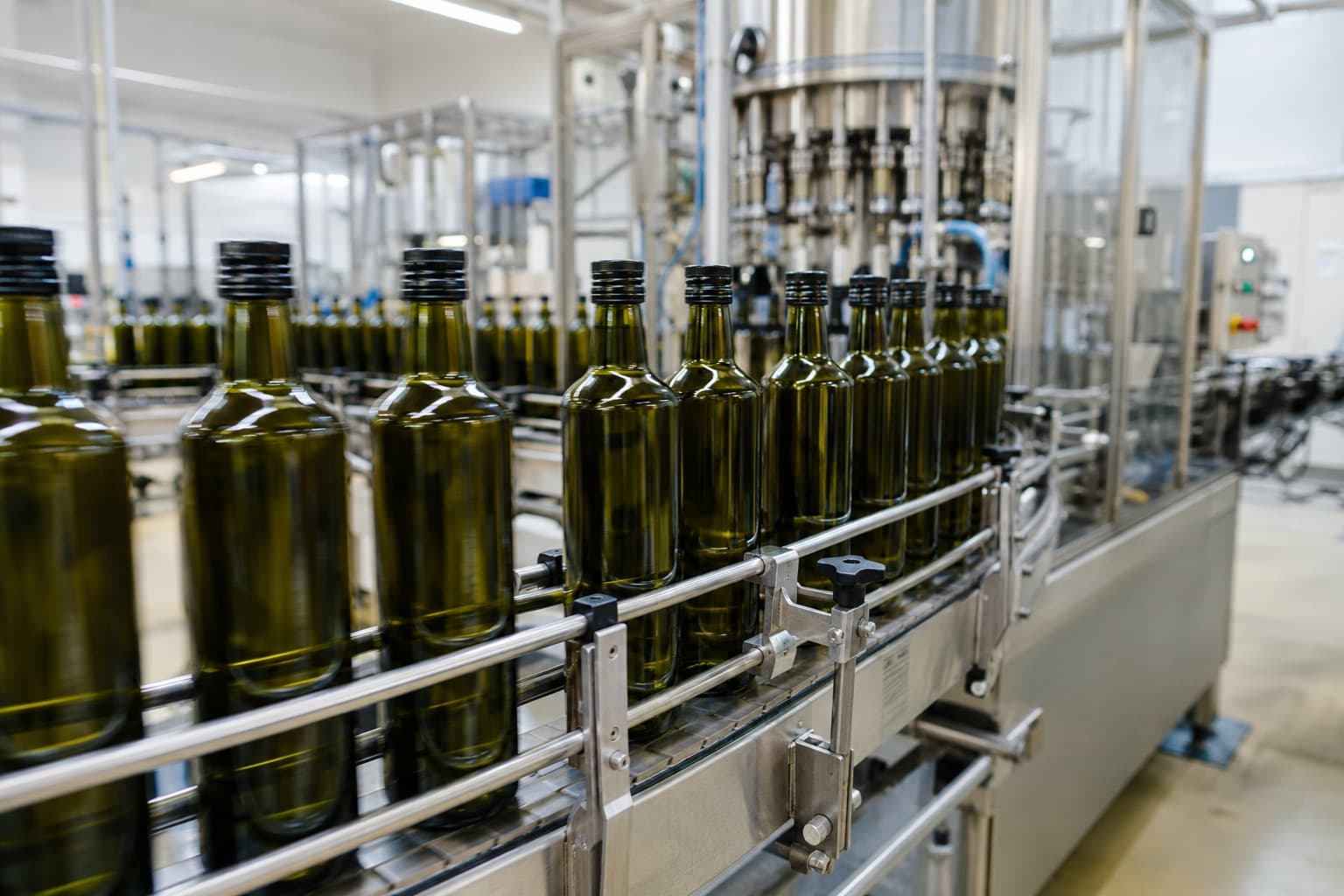
A bottling site running several brands and several oils does not become kosher simply because the bulk oil it receives is: the site itself needs its own certification, either a dedicated production window or a mashgiach present on the line, or the finished product loses the benefit of upstream supervision. For a kosher private-label olive oil program, that requirement layers on top of — rather than replacing — the usual steps: sample-and-COA sign-off, label compliance for the destination market, run-size planning. Every bottled lot then ships with two separate, complementary documents: its kosher certificate and its certificate of analysis, neither one standing in for the other.
The markets that ask for it
Demand is not spread evenly. The North American kosher food distribution market, dense and organized around a handful of recognized agencies (OU, OK, Star-K, KOF-K), expects the symbol on the label before it will list an oil on shelf or use it as an industrial ingredient. Demand spikes seasonally around Passover, when Kosher for Passover status becomes the deciding factor for marketers. Israel runs its own kashrut system, separate from the US agencies and to be qualified independently. In Europe — London, Paris, Antwerp, Manchester — kosher distribution networks serving sizeable communities are a genuine outlet for bottled Tunisian olive oil, with documentation expectations comparable to the North American market.
What to check before you sign
- The exact scope of the certificate — mill and storage included, or bottling only: two very different guarantees.
- The agency and its recognition in the target market — a symbol accepted in Europe is not automatically accepted by a US buying group or an Israeli importer.
- Passover status, separate from year-round kosher status, requested explicitly whenever the end market needs it.
- Supervision continuity on the bulk container — a new, sealed flexitank, or a reusable isotank with a documented, agency-approved cleaning history.
- Audit frequency and the current certificate's validity date, confirmed in writing.
- Consistency between the kosher certificate and the COA — two documents per lot, never one substituting for the other.
Build the kosher file before the season starts
Kosher sourcing is not something you settle at loading time; it gets built with the mill ahead of the season, alongside a lot's analytical profile. Virginia scopes this kind of requirement from the brief onward — lot origin and process, the chain of containers from bulk through bottling — so you can line up supervision with the agency of your choice without hitting a documentation wall at loading. Request a quote and tell us your kosher agency and target market: we'll build the file together, COA included, on our bulk Tunisian olive oil volumes.
Read next

QualityMarket
Olive Oil Authentication: NMR, Isotope and DNA Testing
NMR, stable isotope analysis and DNA testing: the methods that authenticate a lot beyond a standard COA, as Italy and Spain tighten anti-fraud controls in 2026.
August 7, 2026 · 7 min read
GuidesQuality
PPWR: New EU Packaging Rules for Olive Oil in 2026
Weight minimisation, a PFAS cap, recyclability grades and recycled content: the EU PPWR timeline for glass and PET olive oil packaging, explained.
August 3, 2026 · 7 min read

Tell us what you need.
Volume, grade, packaging, destination: describe your project and we'll get back to you within one business day with an offer at the best price — or the right questions.