
Storing Bulk Olive Oil: Shelf Life, Tanks and Best Practices
Published on July 10, 2026 · Updated on July 12, 2026 · 7 min
By the Virginia trading team · reviewed by Tarek Neffati, president
A COA describes one moment in the life of an olive oil lot: the day it was loaded. Six months later, in your tanks, those numbers will have moved — the only real question is how fast. Storing bulk olive oil well means slowing down a chemistry you cannot stop, so the lot still meets its grade at bottling and holds it through the best-before date. Here are the practices that matter, their measurable effect on the analysis report, and what each one actually costs.
The four enemies: oxygen, light, temperature, time
Olive oil degradation is, at its core, oxidation. Oxygen attacks the unsaturated fatty acids and forms hydroperoxides — the primary oxidation products, which the COA captures through peroxide value and K232. These unstable compounds then break down into aldehydes and ketones — the secondary products behind rancid taste, visible on K270. A poorly stored lot does not degrade "in general": it degrades on specific parameters, the very ones that define the extra virgin grade in the International Olive Council (IOC) trade standard. The thresholds are covered in our guide to acidity, peroxide value and UV absorbance.
- Oxygen drives the reaction. Cut the oil off from air and oxidation slows to a crawl; every litre of un-inerted headspace above the oil restarts it.
- Light triggers photo-oxidation: the chlorophyll naturally present in olive oil acts as a photosensitiser and accelerates the reaction sharply compared with storage in the dark.
- Temperature is a kinetic accelerator: as a rule of thumb, oxidation speed roughly doubles with every +10 °C. Oil held at 28 °C ages several times faster than oil at 16 °C.
- Time works even under perfect conditions: polyphenols are consumed protecting the fatty acids, fruitiness fades, K270 creeps upward.
One point tends to reassure buyers: free acidity barely moves in a clean, dry tank. It is set at the mill, at crushing. Acidity that climbs in storage points to a different problem — residual moisture or sediment-laden tank bottoms sustaining enzymatic activity.
The shelf-life dashboard
| Factor | Measurable effect on the COA | Prevention | Cost of prevention |
|---|---|---|---|
| Oxygen | Peroxide value and K232 rise, then K270 | Nitrogen blanket, full tanks, EVOH barrier on flexitanks | Low: gas and fittings are marginal against the value of the lot |
| Light | Photo-oxidation: peroxide and K270 rise, colour shifts | Opaque stainless steel, windowless room, opaque covers on IBCs | Near zero |
| Temperature | Kinetics double every +10 °C; above 25 °C, rapid drift | Insulated or climate-controlled room at 15-18 °C | Moderate: insulation and energy |
| Time | Polyphenols and fruitiness decline, K270 rises | FIFO rotation, re-testing at 6 months, bottling schedule | Low: an analysis always costs less than a downgraded lot |
Tank storage: how professionals do it
Food-grade stainless, nitrogen, darkness
The professional standard is a food-grade stainless steel tank in 304 or 316 — 316 offering better corrosion resistance, useful in coastal environments — with a conical bottom for complete drainage and regular purging of sediment. Nitrogen blanketing completes the setup: after filling, the headspace is flushed with nitrogen, then kept under slight positive pressure. Consumption stays modest — most of it happens at filling and after each withdrawal — for a major payoff: deprived of oxygen, the oil all but stops oxidising. Darkness, meanwhile, is free: stainless steel is opaque, and the room simply needs to be too.
The 15-18 °C window
The target is 15 to 18 °C, and never sustained above 25 °C. Excessive cold is not desirable either: below roughly 10 °C, the oil clouds and partially solidifies. This is fully reversible and harmless to quality, but it complicates pumping, and repeated cloud-and-clear cycles do the oil no favours. An insulated, semi-buried or climate-controlled room holds this window year-round without strain.
Full tanks, broached tanks, hygiene
A full tank exposes only a thin surface of oil; a broached tank without nitrogen becomes an oxidation machine, the headspace growing with every withdrawal. Two reflexes: restore the nitrogen blanket after each draw, and move lot remainders into smaller tanks sized to what is left. Between lots, the rule is complete drainage followed by validated cleaning — never top up fresh oil onto old heels, which would contaminate the incoming lot and destroy traceability. This is the standard at our partner mills: stainless tanks under nitrogen, every lot tied to its mill of origin, as part of our quality approach.
Drums and IBCs: managing small bulk over time
Not every volume justifies a tank farm. A 200 L steel drum holds about 180 kg of oil, a 1,000 L IBC about 916 kg. The rules shift with the container: a steel drum with bungs tightened, kept cool and dark, comfortably rides out a full campaign. The polyethylene IBC demands more caution — its walls are translucent and slightly permeable to oxygen — and should be managed on a shorter horizon, in the order of 6 months, ideally under an opaque cover. In both cases, three disciplines apply: strict FIFO rotation (first in, first out, lot number legible on every container), storage away from heat sources, and re-testing at 6 months — acidity, peroxide value, K270 — to establish the lot's real condition before committing it. Choosing between these formats is covered in our guide to drums, IBCs and bag-in-box.
The best-before date: who sets it, what it covers, what it doesn't
The best-before date falls under Regulation (EU) No 1169/2011 on food information to consumers: it is set under the responsibility of the operator whose name appears on the label — in practice, the bottler or packer. No regulation imposes a single shelf life for olive oil; market practice sits between 12 and 18 months from bottling for extra virgin, and it should be backed by the product's actual stability.
Two distinctions are worth stating plainly. First, a best-before date is not an expiry date: past it, the oil is not unsafe, it is simply no longer guaranteed at its optimal properties. Second, sensory life does not coincide with chemical compliance: fruitiness and pungency decline well before peroxide or K270 cross a limit. An oil can remain extra virgin on paper while having lost most of its sensory appeal.
This is where lot composition matters: a polyphenol-rich oil — the typical profile of northern Tunisian Chetoui and early-harvest lots — ages better, its natural antioxidants delaying oxidation. The topic, including the health claim under Regulation (EU) 432/2012, is developed in our article on olive oil polyphenols. The practical takeaway: set the best-before date from the lot's COA and its real bottling date, not by defaulting to 18 months.
Buying with degradation priced in
Shelf life is won at the negotiating table. If a lot must live 8 to 10 months between loading and bottling, buying a peroxide value of 15 meq is a mistake: the extra virgin ceiling of 20 will come under threat before the oil reaches the bottle. Sensible margins at loading: peroxide no higher than 10-12 meq O₂/kg, acidity no higher than 0.5-0.6%, K270 well clear of 0.22. Write those figures into the contract as specifications, referenced to the lot's COA.
Add two safeguards: a systematic re-test before any late bottling — beyond six months after loading — and an explicit time budget. Add up storage at the supplier, transit, your own storage and the intended shelf presence: that total, not the best-before date alone, should dictate your purchase specs.
Transit: seasonal precautions
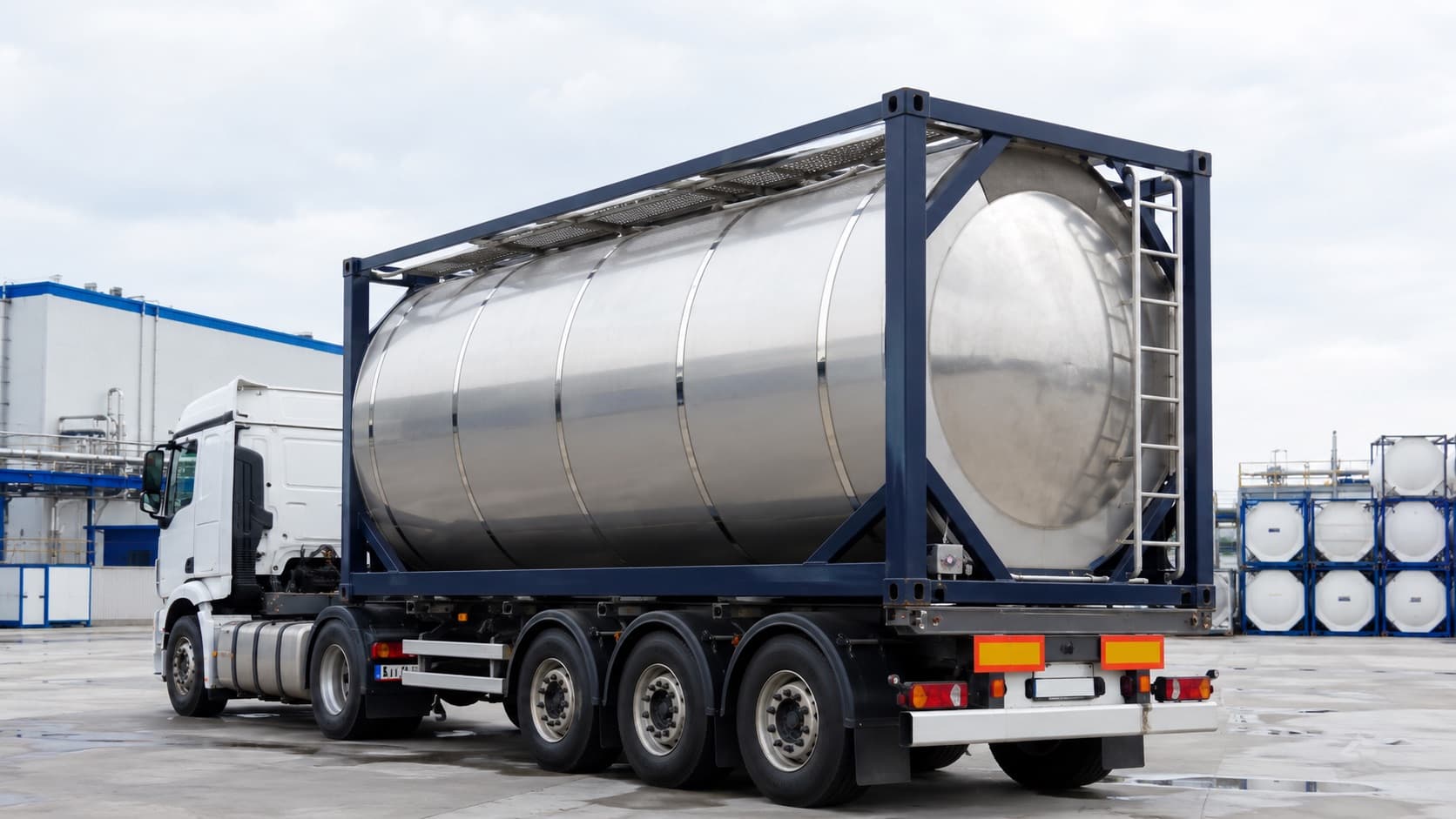
The transport leg can undo in three weeks what the tank farm preserved for six months. In summer, a container standing in full sun on a quay heats well past 30 °C: favour early-morning loading, keep port dwell time short and avoid unnecessary transshipments. In a flexitank, an EVOH barrier limits oxygen permeation during the voyage; on long or hot routes, an isotank adds thermal inertia and temperature control. For drums and IBCs in containers, palletise away from the walls — sun-side thermal bridging heats whatever touches them — and fix the shipping season in the contract when the destination requires it.
Analysis margins matched to your calendar
A lot that has to wait eight months is not bought like a lot bottled the following month. Give us your bottling calendar and we select, at our partner mills running nitrogen-blanketed stainless tanks, a lot whose COA leaves the necessary headroom: low peroxide, K270 well clear of the limit, a re-test scheduled if storage runs long. Start from our bulk Tunisian olive oil page, samples and analysis report included.
Read next
GuidesQuality
Supply Chain Due Diligence (CSDDD) for Bulk Olive Oil Buyers
French vigilance law, Germany's LkSG, the EU's CSDDD: what bulk Tunisian olive oil buyers already need to document from their suppliers today.
August 21, 2026 · 7 min read
Logistics
Ocean Freight for Bulk Tunisian Olive Oil: Book Early
Mediterranean port congestion and volatile freight rates are reshaping bulk shipping costs — what buyers should lock in before the 2026-2027 harvest.
August 17, 2026 · 7 min read

Tell us what you need.
Volume, grade, packaging, destination: describe your project and we'll get back to you within one business day with an offer at the best price — or the right questions.