
Importing Olive Oil from Tunisia to the EU: Customs & Quota
Published on July 8, 2026 · Updated on July 12, 2026 · 8 min
By the Virginia trading team · reviewed by Tarek Neffati, president
Tunisian olive oil enters the European Union through one of two doors: a fiercely contested duty-free tariff quota of 56,700 tonnes per year, or the standard third-country duty of roughly €1,245 per tonne for extra virgin. Between the two sits a document file of about ten items and origin rules that leave no room for improvisation. Here is the full journey of a shipment, from import licence to discharge, with a worked example from Radès to Marseille.
The framework: the Association Agreement and the duty-free quota
Agricultural trade between the EU and Tunisia runs under the Euro-Mediterranean Association Agreement, in force since 1998. For olive oil, its central instrument is a tariff-rate quota of 56,700 tonnes per year at zero duty, originally opened by Regulation (EC) No 1918/2006 and now managed under Regulations (EU) 2020/760 and 2020/761, order number 09.4032.
Three conditions define the quota:
- Virgin oils only: CN codes 1509 20 00, 1509 30 00 and 1509 40 00 — extra virgin, virgin and lampante. Refined oil is excluded.
- Strict Tunisian origin: the oil must be wholly obtained in Tunisia, meaning olives grown and crushed there.
- Direct transport from Tunisia to the EU.
The AGRIM licence: the real bottleneck
The quota is administered through AGRIM import licences, issued by each member state's paying agency (FranceAgriMer in France, BLE in Germany). Applications are filed during the first seven days of December for a quota that opens on 1 January, backed by a security of around €20 per 100 kg, released once the licence is used.
What many buyers discover too late is how heavily oversubscribed the quota is. In 2024, operators applied for more than 3.3 million tonnes against 56,700 tonnes available: each applicant received roughly 1.7% of the quantity requested, and the entire annual volume was allocated in that single first round. In plain terms, no licence secured in December means no zero duty for the rest of the year.
A side note for British buyers: since Brexit, the UK operates its own separate Tunisia quota of just under 5,700 tonnes per year, managed by the RPA under similar licence rules.
Outside the quota: full customs duties
Beyond the quota — or without a licence — the Common Customs Tariff applies. Duties are specific, charged on weight rather than value:
| CN code | Category | Third-country duty |
|---|---|---|
| 1509 20 00 | Extra virgin olive oil | €124.5/100 kg |
| 1509 30 00 | Virgin olive oil | €124.5/100 kg |
| 1509 40 00 | Other virgin olive oils (incl. lampante) | €122.6/100 kg |
| 1509 90 00 | Other (refined and blends) | €134.6/100 kg |
That works out to about €1,245 per tonne for extra virgin — a real cost, but not always a prohibitive one: Tunisian volumes do clear customs at full duty whenever the price gap with Spanish or Italian origins justifies it. Two customs regimes can also defer the burden: customs warehousing, which suspends duty and VAT (useful while waiting for the next quota year to open), and inward processing for oils refined in the EU and re-exported.
The Tunisian side: licensed exporters, no more monopoly
The export monopoly of the Office National de l'Huile (ONH) was abolished in 1994. The ONH remains active in the sector — regulation, promotion, and exporting on its own account — but the bulk of the flow now moves through some hundred approved private exporters.
Two requirements remain on the Tunisian side: the exporter must be entered in the official register of olive oil exporters, and shipments against the EU quota need prior authorisation from the Ministry of Agriculture, applied for at least 7 days before loading. An unregistered exporter or a missing authorisation strands the container at the quay — a point worth verifying with any supplier of bulk Tunisian olive oil before committing.
Proof of origin: EUR.1 or invoice declaration
Zero duty is granted only against preferential proof of origin: either a EUR.1 movement certificate endorsed by Tunisian customs, or an origin declaration on the invoice — reserved for approved exporters, or any exporter for consignments up to €6,000. The "wholly obtained" rule is strict: a blend incorporating oil imported into Tunisia loses the preference. Rare in practice for this product, but fatal in a post-clearance audit, with back duties to pay.
The document file, item by item
| Document | Issued by | What it does |
|---|---|---|
| Commercial invoice | Exporter | Customs value, basis for duty and VAT |
| Packing list | Exporter | Weight check, container and seal numbers |
| Bill of lading (B/L) | Shipping line | Document of title and carriage |
| EUR.1 certificate or origin declaration | Tunisian customs / exporter | Preferential tariff treatment (zero duty in quota) |
| AGRIM licence | Member state paying agency | Drawdown against quota 09.4032 |
| Certificate of analysis (COA) | Exporter's or independent laboratory | Evidence for the declared grade (acidity, peroxides, K232/K270) |
| Health certificate | Competent Tunisian authorities | Fitness for human consumption |
| Organic certificate of inspection (e-COI) | Recognised control body, via TRACES | Marketing as "organic" in the EU |
| Flexitank food-grade certificate | Bag manufacturer / installer | Hygiene evidence for the container |
Two classic traps: an organic e-COI issued after the vessel has sailed (it must be signed in TRACES before departure, or the lot loses its organic status), and a COA that does not cover the parameters checked on arrival.
On arrival: quality checks and labelling
EU marketing standards for olive oil now sit in Regulations (EU) 2022/2104 and 2022/2105, which replaced Regulation (EEC) No 2568/91 and Regulation (EU) No 29/2012. Member states run risk-based conformity checks — documentary review and, where flagged, sampling for physico-chemical analysis and panel test. An oil declared extra virgin that grades as virgin on analysis means reclassification, relabelling and a supplier dispute; hence the value of a full per-lot COA and an independent counter-analysis at loading.
As a food of non-animal origin, olive oil is not subject to the systematic border control posts that apply to animal products; reinforced checks would only apply if it appeared on the list under Regulation (EU) 2019/1793, which is worth checking in its current version. And if the product arrives packed, the label must be compliant from the moment it is placed on the market — categories, origin and storage wording are covered in our guide to EU olive oil labelling rules.
Import VAT: cash-flow neutral in most setups
Release for free circulation triggers import VAT, assessed on the customs value plus duty. Most member states apply reduced food rates to olive oil — 5.5% in France, 4% in Italy and Spain, 7% in Germany — and several, France included, operate postponed VAT accounting: the import VAT is declared and deducted on the same return, with no cash advance, provided a valid VAT number appears on the customs declaration.
Worked example: 22 tonnes in a flexitank, Radès to Marseille
- Contract: the lot is defined by sample and certificate of analysis, with the incoterm agreed — FOB Radès or CIF/DAP Marseille depending on who carries the freight (see our guide to incoterms for olive oil).
- Tunisian authorisations: exporter on the register; ministry authorisation requested at least 7 days before loading if the lot targets the quota.
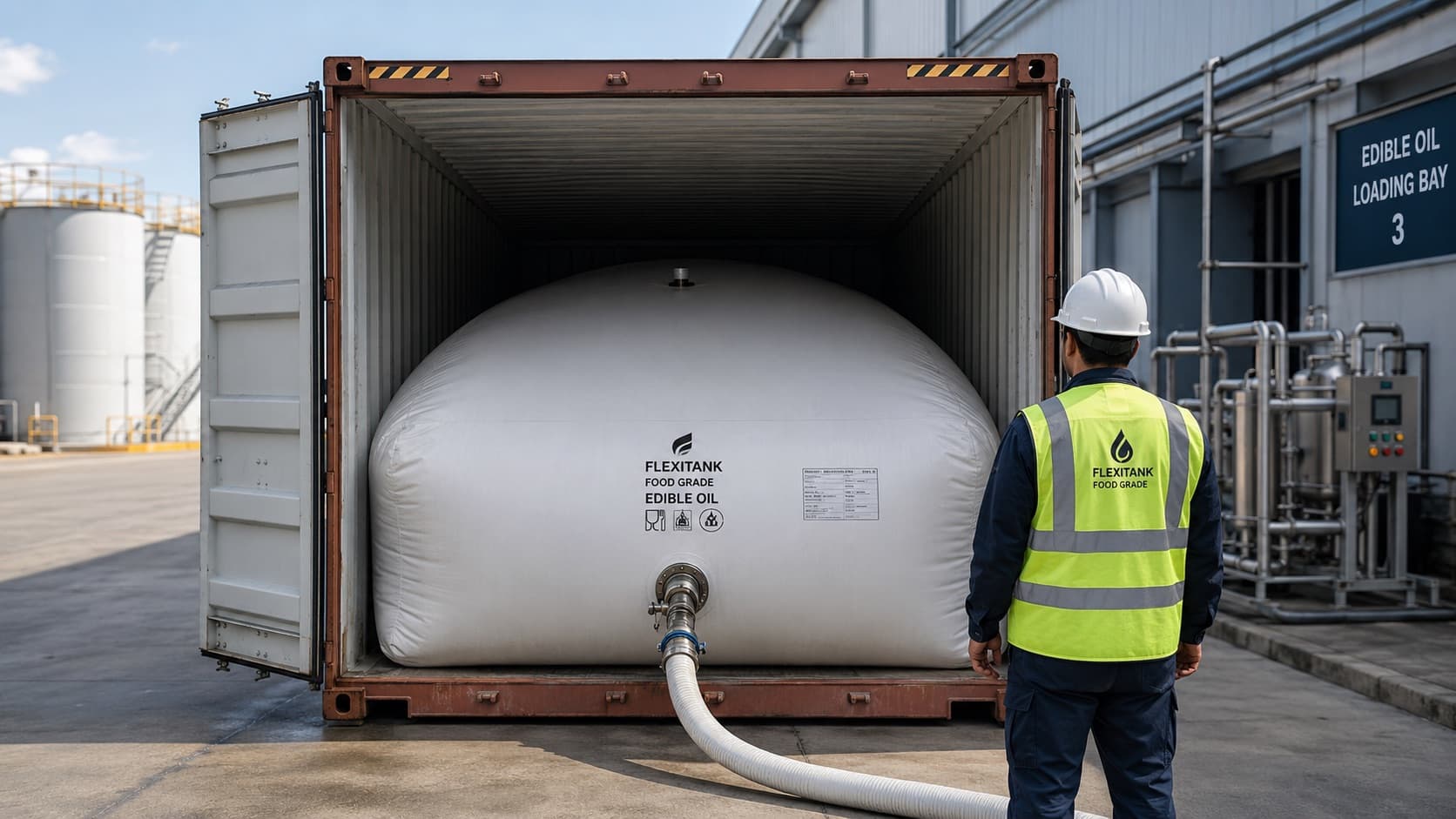
- Loading: a new flexitank fitted in a standard 20-foot container, about 22 tonnes pumped in, seals applied, independent counter-analysis possible at loading — container choice is compared in our flexitank vs isotank piece.
- Documents issued: invoice, packing list, EUR.1 endorsed by Tunisian customs, B/L on shipment, health certificate and COA attached.
- Sea leg: Radès–Marseille is a short trade — a few days on a direct service, longer via transhipment.
- Clearance at Marseille-Fos: declaration for free circulation; EUR.1 plus AGRIM licence for zero duty; VAT handled through postponed accounting.
- Possible checks: documentary control, or sampling by the market surveillance authority depending on risk profile.
- Delivery and discharge: haulage to site, with a pump and buffer tank sized to take the full lot.
On this route the sea leg is a matter of days: it is the AGRIM licence, the Tunisian authorisation and vessel space that set the pace. A confirmed lot typically discharges a few weeks later depending on the season — and none of those milestones should ever be promised as firm dates in a contract.
The document file, ready before the ship sails
Endorsed EUR.1, per-lot COA, health certificate, organic e-COI signed in TRACES before departure: at Virginia, the file travels with the container, not behind it. As a trader of Tunisian olive oil we sell from FOB Radès to delivered site — you decide whether clearance stays with us or with your forwarder. Request a quote and tell us whether you hold an AGRIM licence: we shape the offer, in-quota or full duty, within one business day.
Read next
GuidesQuality
Supply Chain Due Diligence (CSDDD) for Bulk Olive Oil Buyers
French vigilance law, Germany's LkSG, the EU's CSDDD: what bulk Tunisian olive oil buyers already need to document from their suppliers today.
August 21, 2026 · 7 min read
MarketGuides
Exporting Tunisian Olive Oil to the US: Customs & FDA
HTS 1509 duty rates, FDA facility registration, Prior Notice and USDA organic rules: the practical guide to importing Tunisian olive oil into the US.
August 19, 2026 · 7 min read
Tell us what you need.
Volume, grade, packaging, destination: describe your project and we'll get back to you within one business day with an offer at the best price — or the right questions.