
Glass vs PET for Olive Oil: How to Choose Your Packaging
Published on July 17, 2026 · 7 min
By the Virginia trading team · reviewed by Tarek Neffati, president
Switching a 750 mL SKU from glass to recycled PET changes three things at once: the weight you ship, how well the oil is protected from light, and the environmental footprint printed on the finished product. No EU regulation mandates one material over the other — the sector-specific rule caps the container at a maximum volume and requires a tamper-evident closure, not a specific substrate. The decision is purely commercial and technical, and it moves landed cost, shelf performance and brand image all at once. Here's how to make the call.
Two different protection logics, not one universal winner
Glass is a fully inert, total barrier to oxygen — nothing migrates through the wall, whatever its tint. Its light protection, on the other hand, depends entirely on colour: amber glass blocks up to 99% of UV radiation below 450 nm, green glass filters only around 30-40%, and clear glass stops almost none of it. PET works the other way round: it's a partial oxygen barrier, adequate for a 12-18 month shelf life once the headspace is nitrogen-flushed, but uncoloured PET is close to an open window to UV-A while it does block UV-B reasonably well. Pigmented PET (bottle green, amber) or a UV-blocking additive closes much of that gap, at the cost of a material premium.
That difference shows up directly on the certificate of analysis: an oil exposed to light drifts faster on the K270 index, the marker of advanced oxidation. Our guide to acidity, peroxide value, K232 and K270 breaks down what each parameter actually measures — and why the wrong container can push a compliant lot outside spec before it ever reaches the shelf.
What the only serious comparative study actually found
Peer-reviewed literature on this exact trade-off is thin, but a life-cycle assessment published in 2023 in Sustainability (MDPI) compared, across six European distribution scenarios, a standard glass bottle against a 100%-recycled PET bottle for extra virgin olive oil, using the ReCiPe 2018 H method. The result: on global warming potential, particulate matter formation, terrestrial acidification and fossil resource scarcity, the recycled-PET system's impacts came in at under 40% of the glass system's level — a gap driven mainly by container weight, and so by production and transport energy, more than by end-of-life fate. The study doesn't settle the sensory-quality question; it measures environmental footprint, not shelf life.
Weight, cost and how much oil fits in a container
The weight gap at equal volume outweighs every other factor. A standard 750 mL glass bottle typically weighs eight to twelve times more than a PET bottle of the same capacity. Across a full container load, that gap translates directly into less usable oil per shipment: our article on contract bottling already puts a number on the difference between bulk flexitank (21-23 tonnes per 20-foot container) and bottled oil (12-14 tonnes) — glass widens that ratio further against PET at an equivalent format. Unit material cost follows the same pattern: glass stays materially more expensive per unit, though the gap narrows on large formats where PET saves proportionally more material.
| Criterion | Glass | Virgin PET | Recycled PET (rPET) |
|---|---|---|---|
| Oxygen barrier | Total | Partial, adequate for 12-18 months | Same as virgin PET |
| UV protection | Excellent if tinted (amber, antique) | Weak if clear, good if pigmented | Same as virgin PET |
| Weight at 750 mL | Baseline (heaviest) | 8-12× lighter | Same as virgin PET |
| Common retail format ceiling | About 1 L (beyond that: rare, costly) | Up to 5 L | Up to 5 L |
| Transit breakage | Real risk, insured | None | None |
| Recycling loop | Mature closed loop (cullet remelt) | Open loop, quality drops per cycle | Depends on local collection rate |
| Perceived image | Premium, gift, terroir | Economical, practical, bulk | Sustainability story if disclosed |
Breakage is the other line item that rarely shows up in a first-pass cost comparison. Glass claims on a bottled shipment are a recurring, budgeted cost — pallet damage, a cracked case at unloading, the odd flexitank-style bulk incident has its own bottled-goods equivalent — and they're covered, not eliminated, by cargo insurance. PET removes that line entirely: nothing to crack, nothing to adjudicate with an insurer over a damaged pallet corner. On high-rotation, price-sensitive SKUs shipped over long distances, that alone can outweigh the brand argument for glass.
PPWR 2026: recycled content becomes mandatory for PET, not for glass
Regulation (EU) 2025/40 on packaging and packaging waste (PPWR), in force since February 2025, applies from 12 August 2026. Two provisions bear directly on olive oil bottlers. First, food-contact packaging is banned from containing PFAS above defined concentration thresholds, with no phase-out period for existing stock. Second — and this is the point that really shifts the glass/PET arbitration — "contact-sensitive" PET packaging other than single-use beverage bottles must contain a minimum 30% post-consumer recycled content by 2030, rising to 50% by 2040. Glass carries no equivalent recycled-content obligation under the PPWR — its cullet-remelt recycling loop is already treated as mature and near-closed.
In practice, a bottler switching a new SKU to PET now needs to lock in certified food-grade rPET supply, or risk having to rework the packaging supply chain a couple of campaigns before the 2030 deadline. This isn't a distant compliance footnote: preform suppliers are already passing the tightening food-grade rPET market through to their quotes.
No standard mandates the material — but all of them set protection requirements
The International Olive Council's trade standard lists the materials accepted for retail packaging — tinted glass, tinplate, aluminium, PET or other food-grade plastic, multilayer pouches — without favouring any single one, provided the pack protects the oil from light and oxidation and doesn't alter its characteristics. The EU's labelling framework, Delegated Regulation (EU) 2022/2104, follows the same logic: it caps retail containers at 5 litres and requires a closure that can't be resealed once broken, but says nothing about the substrate — our guide to EU olive oil labelling rules covers what has to appear on the label regardless of the container chosen. The material call sits entirely with the buyer, not with a regulatory checkbox.
Which material for which channel
| Channel | Dominant material | Typical format | Main driver |
|---|---|---|---|
| Premium retail, specialty grocery | Tinted glass (amber, antique) | 250-750 mL | Image, maximum UV protection |
| Entry-level private label, promotions | Pigmented PET or lightweighted glass | 750 mL-1 L | Unit cost, shipped weight |
| Foodservice, catering | PET or tinplate | 1-5 L | Cost per litre, zero breakage |
| Long-haul export, price-sensitive markets | Pigmented PET or tinplate | 1-5 L | Shipped weight, zero breakage |
The pattern is consistent: the bigger the format and the longer the shipping distance, the more PET (or tinplate) wins on purely logistical grounds. The closer the positioning gets to a premium or gift purchase, the more tinted glass stays the reference — provided clear or lightly tinted glass is ruled out entirely for an extra virgin oil.
At Virginia: the right container, with the COA to back it
Our bottling partners in Tunisia and Italy work with UV-protective glass as well as pigmented PET and tinplate, matched to your spec sheet and target market. Every bottled lot ships with its own certificate of analysis — acidity, peroxide value, K232/K270 — to confirm the container you picked actually holds its protection promise over time, with SGS counter-analysis available on request. Send us your target formats and volumes through a quote request, or start with samples in both materials to compare side by side: response within 24 business hours.
Read next
Quality
Cold-Extracted Olive Oil: Why the Decanter Matters
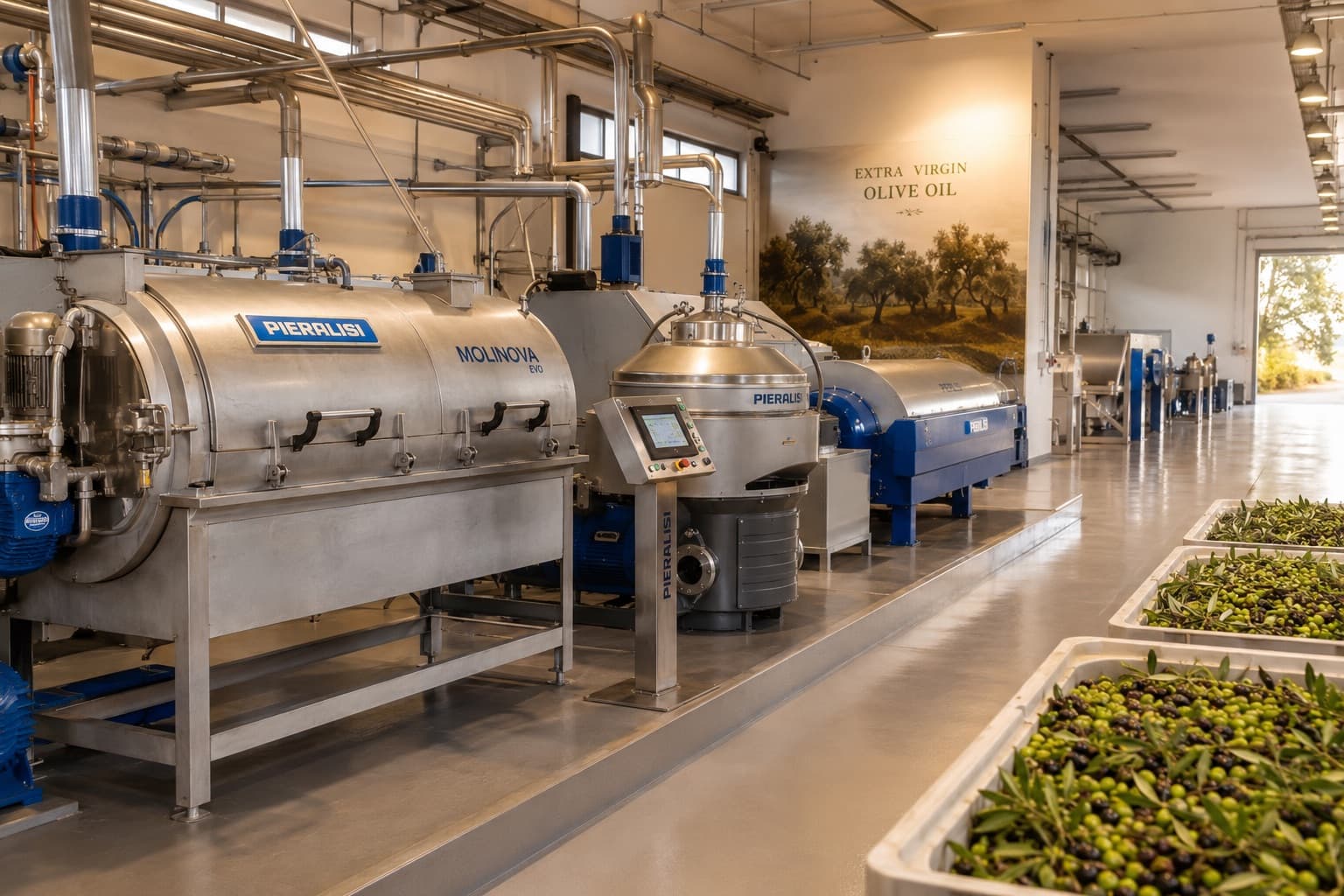
Two-phase or three-phase decanter, malaxation temperature: what actually separates a genuinely cold-extracted olive oil from the rest of the label claims.
August 31, 2026 · 7 min read
GuidesQuality
Deodorized Olive Oil: The Industrial Buyer's Guide
Deodorized olive oil explained: the refining process, uses in frying, canning and cosmetics, and the COA specs to demand before buying it in bulk.
August 28, 2026 · 7 min read
Tell us what you need.
Volume, grade, packaging, destination: describe your project and we'll get back to you within one business day with an offer at the best price — or the right questions.